A simple way to create network protocol headers in typst.
Using tablex under the hood.
Example
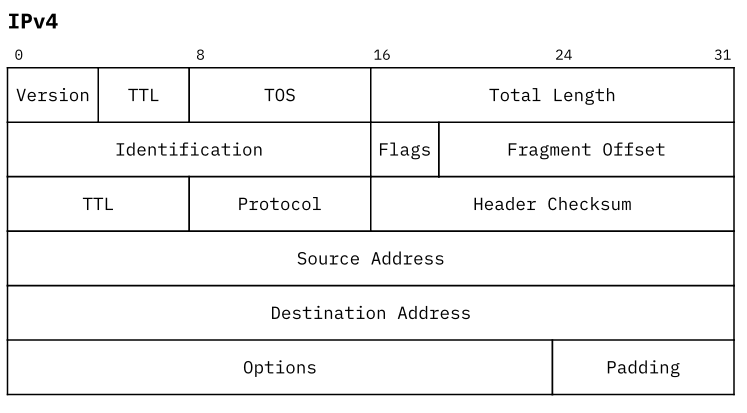
bytefield(
  bits(4)[Version], bits(4)[TTL], bytes(1)[TOS], bytes(2)[Total Length],
  bytes(2)[Identification], bits(3)[Flags], bits(13)[Fragment Offset],
  bytes(1)[TTL], bytes(1)[Protocol], bytes(2)[Header Checksum],
  bytes(4)[Source Address],
  bytes(4)[Destination Address],
  bytes(3)[Options], bytes(1)[Padding]
)
Usage
To use this library through the Typst package manager (for Typst v0.6.0+), import bytefield with #import="@preview/bytefield:0.0.1": * at the top of your file.
The package contains some of the most common network protocol headers: ipv4, ipv6, icmp, icmpv6, dns, tcp, udp.
Features
At the moment very limited features. Feel free to extend if you like.
- Select the number of bits in one row. The default value is 32.
bytefield(bits: 32) - Specify the shown bit numbers in the header through the
headerargument. Example:bytefield(header: (0,8,16,31)) - Select the height of the rows. Default is 2.5em. Example:
bytefield(rowheight: 20pt) - Adding fields with a predefined length of bits or bytes.
- Fields with a length greater than a row will automatically wrap.
- If a field-length is the multiple of a row-length it will automatically render with a higher rowheight. Example see Ipv6.
- Fill up the remaining space of a row with the
paddingfield. - Coloring fields through the
fillargument. For example:bits(32, fill: red.lighten(30%))[Test]
Changelog
v0.0.1
Initial Release
Added bytefield, as main function to create an new bytefield diagram.
Added bit, bits, byte, bytes, padding, as high level API for adding fields to a bytefield.
Added flagtext as a utility function to create rotate text for short flag descriptions.
Added ipv4, ipv6, icmp, icmpv6, dns, tcp, udp as predefined diagrams.